Suicide
In Dante Alighieri's Inferno, suicide is classified as a form of violence against the self, a sin that denies the God-given gift of life and the integrity of the human person. Punished in the second round of the Seventh Circle, the suicides undergo a unique and horrifying contrapasso: they are transformed into gnarled, thorny trees, their human form stripped away, and are perpetually torn and fed upon by the monstrous Harpies. This punishment reflects the essence of their sin—a rejection of one's own body and life—by permanently denying them a human shape and voice, trapping them in a state of mute, vegetative suffering until the Final Judgment, when their bodies will hang lifeless from their branches.
Definition and Place in the Moral Structure of Hell
Virgil, in his comprehensive explanation of Hell's geography in Canto XI, defines suicide as a specific category of violence. He explains that "Man may lay violent hands upon himself / And his own goods; and therefore in the second / Round must perforce without avail repent / Whoever of your world deprives himself, / Who games, and dissipates his property, / And weepeth there, where he should jocund be." This places suicide alongside those who destroy their own goods through profligacy, both being forms of self-violence. The sin is distinct from violence against others (punished in the first round of the Seventh Circle) and violence against God, Nature, or Art (punished in the third round). The suicides are confined to the Wood of Thorns, a dark and tangled forest that is "not marked by any path whatever," with foliage that is "not green, but of a dusky colour," branches that are "not smooth, but gnarled and intertangled," and fruit that is not apples but "thorns with poison." This landscape mirrors the barren and twisted nature of the act itself.
The Contrapasso: Transformation into Trees
The punishment of the suicides is a literal and permanent transformation. When a soul that has committed suicide abandons its body, Minos consigns it to the seventh abyss. It falls into the forest, and "no part / Is chosen for it; but where Fortune hurls it, / There like a grain of spelt it germinates." The soul then "springs a sapling, and a forest tree." The soul is thus rooted in place, unable to move or speak freely. The Harpies, creatures with "broad wings," "necks and faces human," "feet with claws," and "great bellies fledged," nest in the trees and feed upon their leaves, causing pain and providing an outlet for the suffering. The souls can only speak when their branches are broken, and their words emerge mingled with blood, as when Dante, at Virgil's suggestion, breaks a twig from a great thorn and hears the trunk cry out, "Why dost thou mangle me?" The blood and words flow together "as out of a green brand, that is on fire / At one of the ends, and from the other drips / And hisses with the wind that is escaping." This contrapasso denies the suicides the human form they rejected, fixing them in a state of passive, agonized vegetation.
The Fate of the Body at the Final Judgment
The suicides' punishment extends beyond the present torment to the final resurrection of the flesh. Pier della Vigna, the most prominent soul in this circle, explains that after the Last Judgment, the souls of the suicides will return to retrieve their bodies, but they will not be reunited with them. Instead, the bodies will be dragged into the forest and "suspended be, / Each to the thorn of his molested shade." The reason given is that "'tis not just to have what one casts off." Because the suicide deliberately rejected and destroyed his own body, he forfeits the right to ever wear it again. This final, eternal separation from the body is the ultimate consequence of the sin, a permanent reminder of the act of self-destruction.
The Case of Pier della Vigna: The Sin of Despair and Injustice
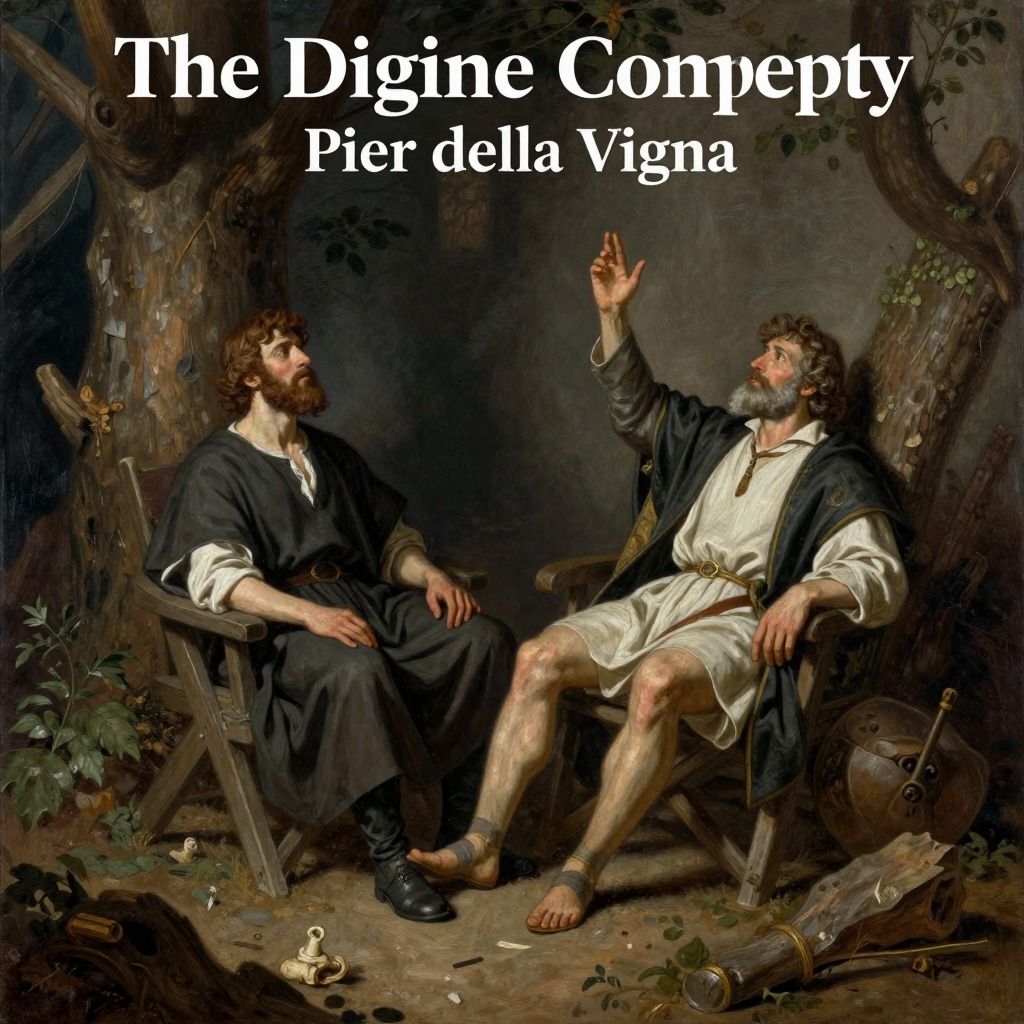
The most detailed and poignant encounter in the Wood of Thorns is with the soul of Pier della Vigna, the former chancellor and confidant of Emperor Frederick II. Pier della Vigna describes his former life: he was the one who "both keys had in keeping / Of Frederick's heart, and turned them to and fro / So softly in unlocking and in locking, / That from his secrets most men I withheld." He bore such fidelity to his office that he lost "thereby my sleep and pulses." However, the "courtesan who never from the dwelling / Of Caesar turned aside her strumpet eyes"—that is, Envy—inflamed the other courtiers against him, and they in turn inflamed the Emperor, so that "my glad honours turned to dismal mournings." In response to this unjust persecution, Pier della Vigna, in "disdainful exultation, / Thinking by dying to escape disdain, / Made me unjust against myself, the just." He committed suicide to escape the false accusations, but in doing so committed a greater injustice against himself. He swears by the roots of the tree that he never broke faith with his lord, who was "so worthy of honour." His story illustrates that suicide, even when motivated by a sense of injustice or despair, is itself an act of self-betrayal and a rejection of God's order.
The Violent Against Themselves: The Profligates and the Hunt
The second round of the Seventh Circle also punishes those who destroyed their own goods through profligacy, a form of violence against one's own substance. These souls are not transformed into trees but are chased through the forest by black, ravenous she-mastiffs, who tear them limb from limb. Dante witnesses two such souls fleeing naked and scratched: one, Lano, is overtaken and hides behind a bush, but the mastiffs set upon him and "lacerated him piece by piece, / Thereafter bore away those aching members." The other, Jacopo da Sant' Andrea, is the one who had crouched down and is torn apart. The bush that Jacopo used as a screen is itself a suicide tree, which cries out in pain, "What helped it thee of me to make a screen? / What blame have I in thy nefarious life?" This juxtaposition shows that the sin of self-destruction extends beyond literal suicide to any reckless waste of one's own life and resources, and that the punishment is a violent, bestial rending that mirrors the soul's own violent disregard for its own being.
Thematic Significance: The Rejection of Self and the Body
Suicide in Dante's moral universe is a profound rejection of God's gift of life and the integrity of the human person. The contrapasso of being turned into a tree—a form that is alive but not human—emphasizes the loss of humanity that the sin entails. The suicides are denied the ability to move, to speak freely, and ultimately to be reunited with their bodies. Their punishment is a permanent state of isolation and pain, a direct consequence of their act of self-isolation and self-harm. The episode of Pier della Vigna further explores the theme of justice and injustice: the suicide, in seeking to escape an unjust fate, commits an even greater injustice against himself, and his eternal punishment is a testament to the inescapable nature of divine justice. The Wood of Thorns stands as a grim warning against the despair that leads one to take one's own life, a sin that Dante places among the most severe in Hell.